Refrigerator Repair
Sub-Zero fresh food warm but the freezer still frozen: what that split means
A Sub-Zero built-in whose refrigerator side sits near fifty while the freezer stays rock hard is telling you something specific. Here is what the split rules out, what to check in a Phoenix kitchen before calling, and where the diagnosis needs gauges.
A Sub-Zero built-in that has gone warm on the refrigerator side while the freezer is still making ice is one of the most useful faults there is, because the split narrows the problem down before anyone opens a panel. It also worries people more than it needs to: this pattern usually points at a part that costs a fraction of what a sealed-system repair does.
What the split actually tells you
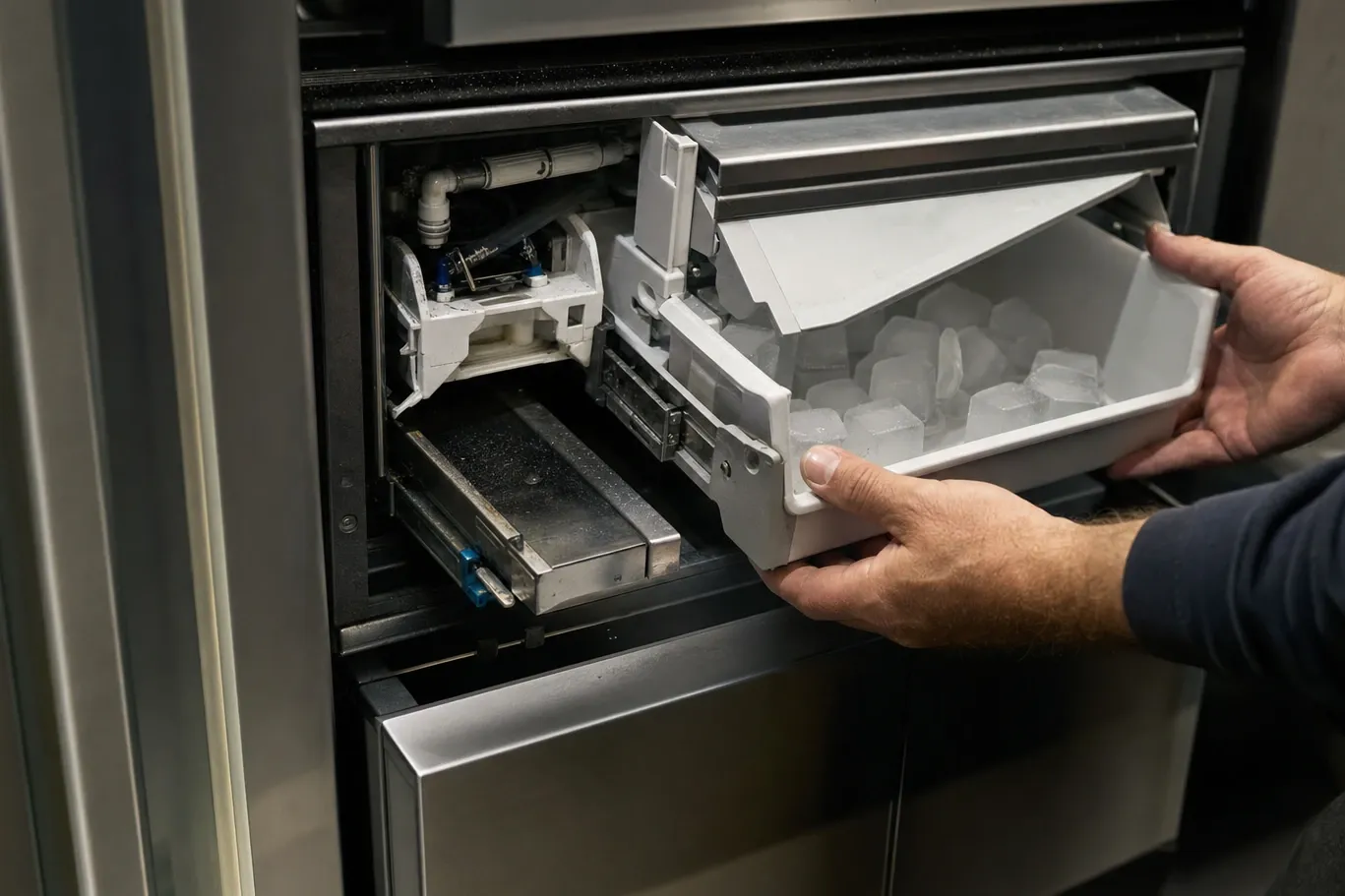
Most built-in Sub-Zero units — the classic side-by-sides, the 600 and 650 series, and the integrated and column models — run two separate evaporators, one per compartment, fed by one compressor. That architecture is the reason the split is informative.
If the freezer is holding at or near zero, then the compressor is running, the sealed system has charge, and the condenser is rejecting at least enough heat to keep one evaporator cold. A total loss of refrigerant or a dead compressor cannot produce a hard-frozen freezer. So the split rules out the two most expensive failures in one glance.
What it leaves is a problem on the refrigerator circuit specifically: cold is being made and is not being delivered to the fresh-food compartment. That is a much shorter list.
Four things to check before you call anyone
None of this needs tools beyond a flashlight and a thermometer.
- Put a real thermometer in the compartment. A glass of water on the middle shelf, left an hour, read with anything you trust. Displays drift, and a control reading 38 while the shelf sits at 50 is itself a finding worth reporting.
- Hold the door switch in and listen to what the refrigerator side is doing. What you want to hear is a fan turning inside the cabinet, not only the compressor working away underneath. Most models cut the interior fan the instant the door swings open, so the switch has to be held closed for the test to mean anything — and silence while you hold it is worth writing down.
- Look for frost patterns. A neat sheet of frost on the rear interior panel of the refrigerator side, or a fan that sounds like it is hitting something, both point at ice where air should be moving.
- Pull the grille and look at the condenser. After a summer of blowing dust, the coil in a Phoenix kitchen can be carpeted. This is the one thing on the list you can also fix.
Write down what you find. Two sentences of observation shortens a visit more than any amount of description of how bad it has got.
What it usually turns out to be
In rough order of how often it is the answer:
- A failed evaporator fan motor on the refrigerator circuit. The classic version of this fault. Cold is made and never moved, so the freezer stays hard and the fresh-food side climbs into the forties and fifties. Usually a motor, occasionally a blade fouled by ice.
- A condenser choked with dust. The unit cannot shed heat, so run times stretch and the refrigerator side — which has the smaller demand and the longer air path — loses first. In this metro it belongs near the top of any list.
- A defrost fault on that evaporator. Ice builds until it blocks airflow entirely. The giveaway is a compartment that improves for a day after being emptied and left open, then slides back.
- An air damper or diffuser stuck shut on models that share air between compartments.
- A drifted thermistor. The control believes the compartment is already cold enough and stops calling for cooling. Cheap part, and one that gets missed when the diagnosis starts at the compressor.
- A door that has stopped sealing. Come July, rubber that has gone stiff — or a hinge sagging far enough to hold one corner open — feeds 100-degree kitchen air into the compartment all day long. It presents as a refrigeration failure and it is a rubber problem.
When the diagnosis needs gauges
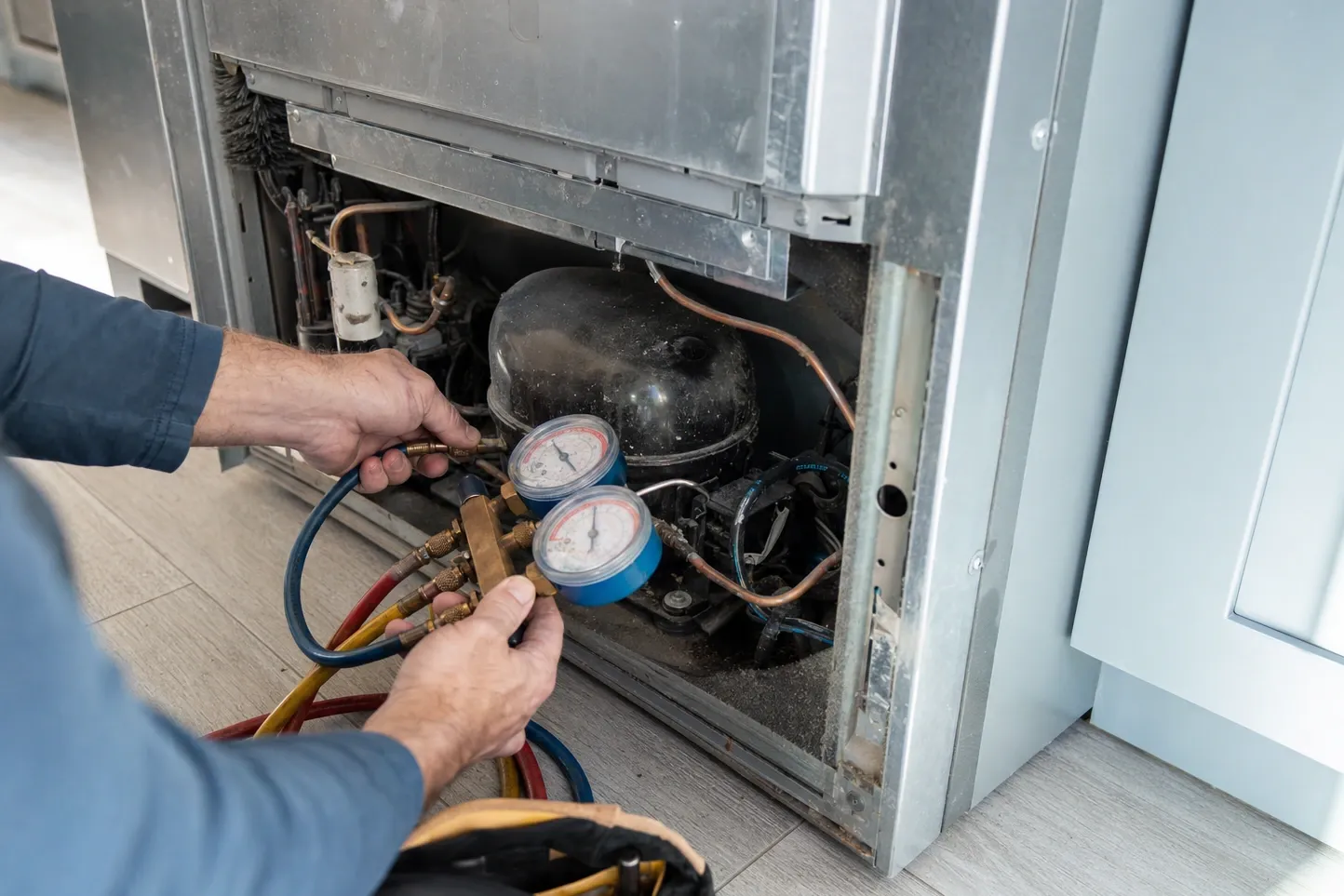
Sometimes the split is not as clean as it looks. If the freezer is at ten degrees rather than zero, or the compressor genuinely never cycles off, then both circuits are underperforming and the story changes: now a partial restriction, a weak compressor or a low charge is back on the table, and that is manifold-gauge work. Pressures get read against ambient temperature — which in a Phoenix kitchen in August is not the number the textbook assumed — and a leak that is merely topped up will be back before next summer.
This is also where a proper diagnosis pays for itself. A fan motor and a sealed-system repair present almost identically in the first thirty seconds and are nowhere near each other in cost, so the point of the visit is to tell you which one you have before anything is ordered.
Living with 110-degree afternoons
Two habits keep a built-in out of trouble here. Clean the condenser twice a year rather than once — after the spring dust and again after the monsoon — and keep the toe grille and any rear clearance clear of stored boxes, rugs and pet hair. A built-in was designed to breathe through a narrow slot, and that slot is the first thing a remodel or a busy kitchen blocks.
The other habit is measuring. If you know what your compartments normally read on a hot afternoon, you will catch the next fault a week earlier — and a week earlier is often the difference between a fan motor and a freezer full of spoiled food.
Follow-up questions
- Can I just turn the temperature dial down to compensate?
- It rarely helps and it can make things worse. On a dual-evaporator built-in the control is already calling for cooling on that circuit; if cold is not arriving, asking for more cold only makes the compressor run longer in a hot kitchen. Turning it down also masks the symptom for a day or two, which is long enough for food to sit in the danger zone unnoticed.
- How long should a Sub-Zero take to recover after the doors have been open a while?
- A healthy built-in pulls the fresh-food compartment back down within an hour or two of normal use, and a freezer that has been opened repeatedly can take three or four hours. If a compartment has not recovered overnight with the doors shut, stop waiting and get it read — a unit that never recovers is not a unit that was simply asked too much of.
- Is it worth cleaning the condenser myself?
- Yes, and in this valley it is the single most useful thing an owner can do. The grille comes off at the top or bottom depending on the model, and the coil takes a soft brush and a vacuum. Do it with the unit unplugged, do not bend the fins, and if the coil is packed solid with dust and pet hair expect a noticeable improvement in run time afterwards.
Past the point of a screwdriver? The refrigerator repair page sets out what a visit involves, or call (623) 240-9400.